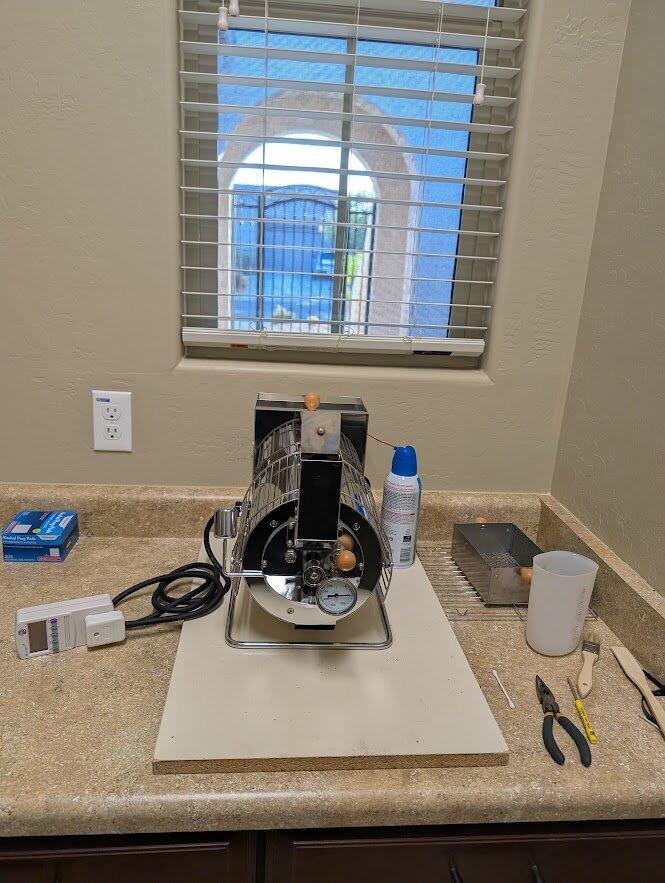
Quest M3s Coffee Roaster
Product Overview
Product Overview
The Quest M3s now comes with one analog thermometer in the face, insulation around the drum and a chaff collector under the drum.
It's hard to define what the Quest M3s Coffee Roaster is, exactly; it falls in-between the current categories of small-scale coffee roasters. It is hand-built, one at a time, in a small workshop factory in Taiwan. It has no advanced electronics, no motherboard or chipset, no heat profiling or automated cooling cycle. This is basically a miniature shop roaster scaled down to sample roaster size. It is a very manual machine and therefore most suitable for an experienced professional coffee roaster. It's not a Probat sample roaster (nor is it priced like one!) Yet it has some similar features: a sample trier so you can view coffee from the drum while roasting, a sight glass to see roast progress, manual temperature control (a dial adjusted gauge shows you the amperage sent to the heat elements), airspeed control (fan speed controls volume of air pulled through the drum. A timer essentially functions as an on/off switch and allows you to cool the roaster down when you are finished with your batches, as well as acting as a safety shut off if the roaster is left unattended. It has an ingeniously simple way to cool the coffee; you dump the batch into the tray like a little shop roaster, open the rear door to the chaff collection chamber, and set the tray there so cool air can be pulled through it. Outside-the-drum cooling in 3 minutes or so ... another great advantage over most home roasters. Important! Turn the amperage all the way down when cooling your coffee. The drum will retain heat with the amperage down, but if left on it can overheat the roaster.
The Quest is designed for continuous roasting, once it is properly warmed up you can roast for hours. In fact, this is the way to use the machine, as heating it up to do one batch and cooling it back down right away could cause wear and tear on the drum. So, in this sense, it is much more like professional sample roaster. The Quest M3s has lots of power and, as a miniature shop roaster, it requires a knowledgeable operator too. You can have a chaff fire in a hurry without cleaning it, and it's not so consumer-oriented in safety design either; like a Probat, there are lots of hot surfaces to remind you where your fingers should and should not be during roasting.
With an Allen wrench and a screwdriver, the Quest M3s can be stripped of its bodywork, the drum pulled out of the motor drive, and any part accessed in minutes. It is incredibly straightforward in terms of wiring and parts. For example, it uses a commonly available computer fan for air intake. Heating elements can be changed out quickly if need be. It is ready for any type of modification you might desire, such as PID control of the burners. (Not that I would want to automate anything here - the idea is a manual roaster with a trier to pull samples. Yes, it's a tiny, tiny trier but it works!) We did have trouble with the initial heating elements sent with the machines, but we worked with the manufacturer so now the heating elements have a higher electrical rating (up to 130v). The Quest M3s is very quiet and runs on standard US voltage (120v, 60 hertz). You'll be impressed with the ease, convenience, and consistency that you can achieve roasting coffee with this electric roaster.
The ideal batch size is 120 grams which are a rather standard load for a modern electric Probat roaster. The absolute maximum batch size is 200 grams. Dimensions: 14.25" x 9.5" x 11.75" The Quest has a 30 Day Warranty, parts are available for sale after warranty- for parts and warranty service contact: questm3roaster@gmail.com We require previous roasting experience and signed Terms of Use. Processing of orders may take additional business days until this verification is complete. Full instructions for use can be found in the Quest M3 instruction manual.
*Digital thermometry is a really nice addition and invaluable for roast temperature accuracy! Check out our Quest-Compatible Thermal Probe and Digital Thermometer for a plug-and-play solution.
Specs
Specs
Technical Specifications
Key specifications and operating details for this product.
| batch size | 90-200 g |
|---|---|
| control |
Amps for heating element
Fan speed |
| roast time | Variable |
| heating source | Electric element |
| dimensions | |
| capacity | |
| material | |
| warranty | 30 Days |
| cons | |
| volts watts |
Reviews
Reviews
I came from a Hottop Basic that was old and some parts were no longer available.
For my next roaster I did not want expensive parts that could become obsolete, such as a circuit board and the control panel. This roaster is perfect for me. I also have no desire to use artisan software.
I plug it into a Kill-A-Watt so I can better track the amperage. I prefer looking head-on to the roaster so I can track the roast through the site glass. I can see enough of it that I do not feel it is necessary to use the trier. It is easy to burn your fingers while using the trier, such as coming into contact with the thermometer. All of the metal on the roaster other than the large handle to release the beans will be too hot to touch, even an hour after roasting it is too hot.
I roast 227 grams regularly and it handles it fine. I have roasted up to 235g and it worked fine too.
I liked how the Hottop had repair videos and they had tremendous support. I wish this roaster had similar support. I have run a couple hundred roasts through this roaster without any issues yet.
I have taken off some of the body for cleaning. That can be done using both 2.5mm and 3mm Allen wrenches. I have not removed the drum yet and am not sure how difficult it would be to do. Better support for this would be wonderful.
The bottom knob is for the ash collector. Not much ends up in it. The wooden knob on the ash collector gets a bit warm to touch so be quick about it.
The chaff is collected in the rear box section in a screen filter. It needs to be emptied with each roast. I can get the screen filter out with my fingers by placing them inside of the screen without burning myself.
I like the thermometer. You get a feel for what will happen where. I don't know how accurate it is. It is very consistent though and that is all that matters to me.
The beans turn yellow at around 300 degrees. Brown is 330 to 340. First crack is at 365 to 375. I finish the roast at 400 or a little after, which is before second crack starts. I preheat it to 330 and keep the amps close to 10.0 for most of the roast. I have run six consecutive roasts through it regularly without any issues. It is nice to not wait for 20 minutes between roasts.
I highly recommend this roaster. I looked around a lot when I needed another roaster and this one fit my needs the best.